Friday, 20 April 2018
Joseph Nicephore - The man who drew with light
In 1827 a Frenchman by the name of Joseph Nicephore, was playing around with a technique called holography. He conducted an experiment which involved pointing a camera out of a window, positioning it so that the lens would cast an image onto a pewter plate, coated with a light sensitive filament. Eight hours later the image above was created and is believed to be the oldest known surviving photograph.
Joesph Nicephore Niece, the first man to draw with light.
Tuesday, 24 October 2017
The Triple Star System, Gliese 667.
Sunday, 22 October 2017
Statue of David by Michelangelo.
King David is regarded in biblical texts as a humble, honest and dedicated king whilst serving the needs and will of the people he ruled over at the time. Davids father Jesse was a farmer and lived in Bethlehem, he was of the tribe of Judah and his family are belived to have stemmed from the genology of Jesus Christ. Jesse had eight sons including David. In Biblical texts it is thought that the prophet Samuel was sent by God to find the next King of Isreal. The prophet presented each of Jesse's sons to God until God asked the prophet Samuel to annoint David, King over Isreal.
Hebrew prophets regarded him as the ancestor of the future messiah and according to the new testament he was the ancestor of Jesus. As Biblical texts go, the basic story of David goes that David was handed into the hands of King Saul ( King of Isreal ) to protect and take care of the King as one of his royal armour bearers. One of the most recognised stories about David is the story of David and Goliath, which tells us of a time when the Philistines and the Isrealites came to war with each other. The giant known as Goliath from the Philistines, challanged the Isrealites to send out their most decorated champion to fight him in a head to head battle. David stepped forward and killed Goliath with no more than a slingshot and a few stones.
The marble sculpture was created between 1501 and 1504 by the Italian sculptor, painter, architect, and poet Michelangelo. This masterpiece stands around 17ft tall, located at the Galleria dell'Accademia ( Gallery of the Academy of Florence ) in Florence, Italy.
Sunday, 15 October 2017
The Majestic Moon's of Jupiter.
Image of Jupiter and two of its largest moons.
Jupiter's largest moon's Io and Europa were first discovered by Galileo Galilei whilst he was making observations of the night sky with his own personal telescope in 1610. The mythological character Zeus was another representation of the planet Jupiter, therefore Galileo named the two moon's of Jupiter after two lovers of Zeus, Io and Europa. Galileo recognised that not all celestial bodies orbited the Earth, this realisation would change the course of history forever. At the time of his discovery most astronomers believed that the Earth was at the centre of the Universe, now atronomers had to consider that Earth was simply apart of a much bigger Universe than previously thought. 400 Years later we have discovered 69 moons that orbit Jupiter with the use of Space Probes like the one that captured this stunning image.
The image was captured by Nasa's JUNO Space Probe on September 1st 2017.
Image credit: NASA/JPL-Caltech/SwRI/MSSS/Roman Tkachenko.
Link to image.
Tuesday, 28 March 2017
Pillars of Ashoka
The pillars of Ashoka are a collection of pillars dispersed throughout the Indian subcontinent, during Emperor Ashoka's reign of the Mauryan Empire.
The Emperor had inscriptions carved into the pillars, containing information about the Emperor's beliefs and ideas towards the teachings and philosophies of Buddhism. The pillars stand roughly 15 meters in height and weigh about 50 tons each. These pillars where then sent to areas like Pakistan, Nepal, Afghanistan and Bangladesh. The pillar shown in the image is believed to be one of 30 sandstone pillars inscribed with a Buddhists based moral code. The four lion pillar was constructed by Emperor Ashoka. The lion figure has since become the Republic of India's modern national emblem.
Friday, 17 March 2017
VY Canis Majoris.
Saturday, 11 March 2017
Mystic Mountain
The Mystic Mountain is vast area located roughly, 7,700 light years away from Earth in the Carina Nebula. The mountain is a stellar nursery, home to newly born stars, reaching a peak of around 3 light years (17,670,000,000 000 miles) in height. The stars surrounding and forming within the cloud, gives of huge amounts of heat and radiation, which ionizes the surrounding gases, causing them to glow.
The image above was captured by Wide Field Camera 3 on the Hubble Space Telescope.
Sunday, 12 February 2017
Ring Nebula (Messier 57)
Messier 57 (M57) also known as the Ring Nebula, sits 2,300 light years away from Earth, in the constellation of Lyra and is roughly 1 light year in size. Its understood that the nebula would of once been a giant sun like star, before its outer shells where blown apart, as the star began its transformation into a white dwarf. The star at the center of the nebula is made up mostly of Carbon and Oxygen. It is roughly 200 times brighter than our own sun and has a surface temperature of around 125,500 ± 5,200 kelvin. The blue hue that surrounds the star is Oxygen gas that has been ionized by the central star, whilst the red hue is a mixture of both Hydrogen and Nitrogen. The red wavy structures surrounding the nebula would have been the first layers of material ejected from the star, as it began to evolve into a white dwarf.
The nebula was first discovered by Antoine Darquier de Pellepoix, who was a french astronomer, in January 1779. The nebula was first photographed by the Hungarian astronomer Eugene von Gothard in 1886.
This image above is composed of visible light data took from the Hubble Space Telescope and infrared data collected from the ground based Large Binocular Telescope in Arizona.
Monday, 6 February 2017
NGC 6357

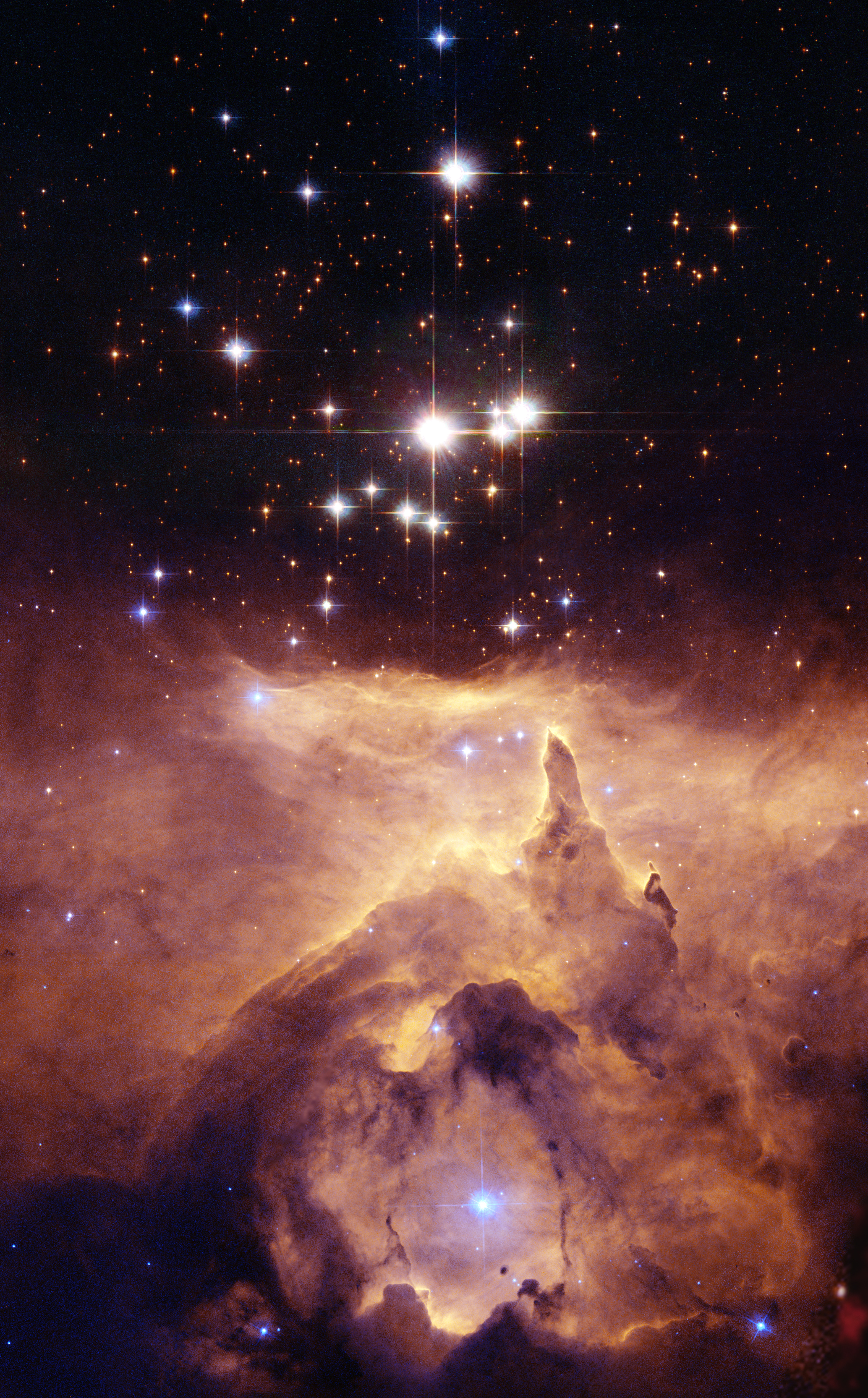
NGC 6357 is a gigantic cloud of interstellar gas and dust, made up of copious amounts of hydrogen, which makes it the perfect spot for star formation to take place. The nebula sits 8,000 light years away from Earth in the constellation Scorpius. The nebula is home to three popular know star clusters called G353.1 + 0.36, G353.2 + 0.7 and Pismis 24. Both star clusters, G353.1+0.36 and G353.2+0.7 hold around 1,600 stars. Pismis 24 is the third star cluster which contains various massive stars such as Pismis 24-1, which is estimated to be 300 times bigger than our own Sun and can be seen in the image above, near the center of the nebula.
The image above was captured by the Hubble Space Telescope.
Thursday, 2 February 2017
Thors Helmet- NGC 2359

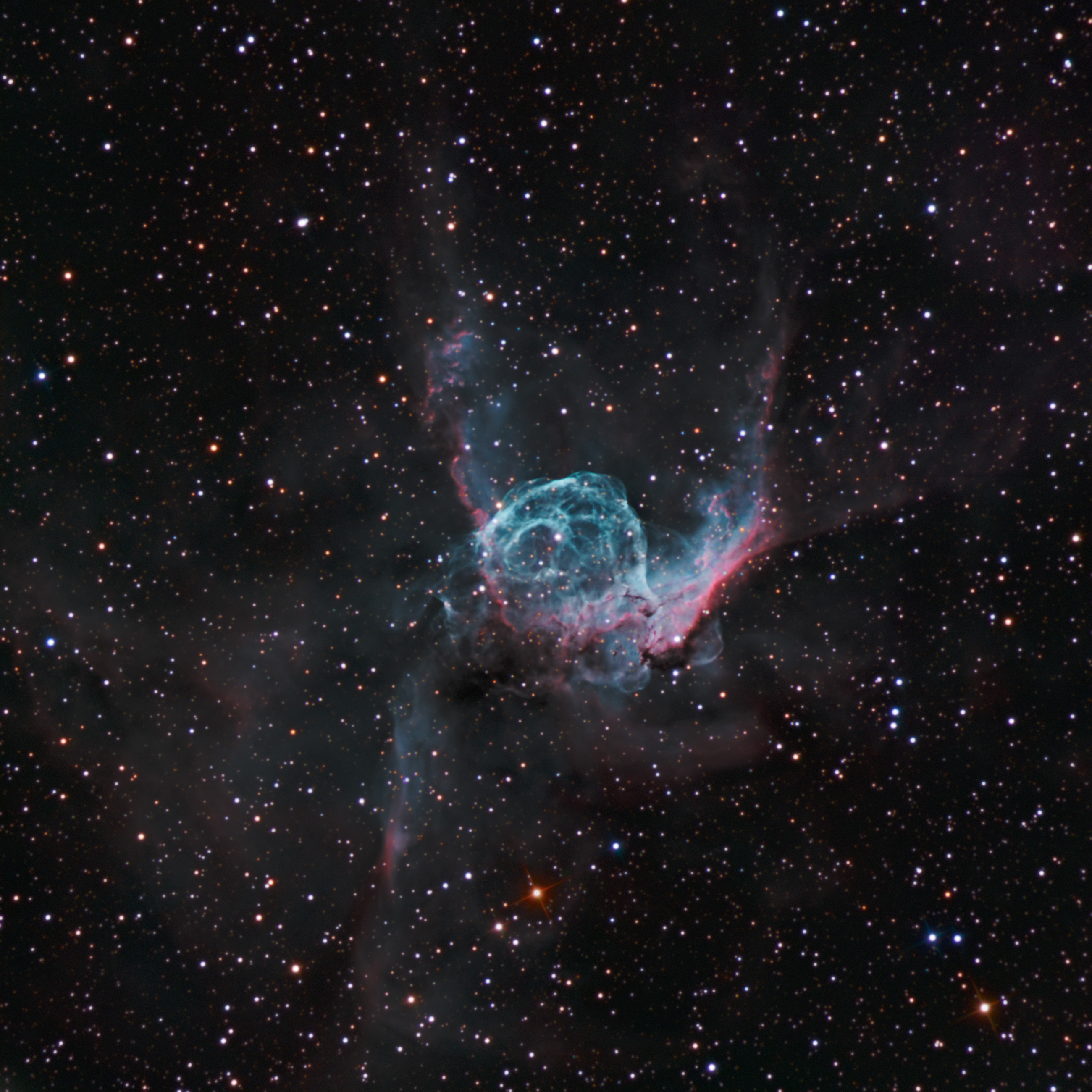
NGC 2359 sometimes referred to as Thors Nebula, is the title of a nebula located 12,000 light years away from Earth, in the constellation Canis Major. The nebula is roughly 35 light years in length and holds a huge Wolf Rayet Star at its center. This Wolf Rayet Star is massive, it has completely burnt off its outer layer of hydrogen and has left helium and heavier elements fusing in its core. It is estimated to have a surface temperature between 30,000 and 250,000 kelvin and is calculated to be thousands of times brighter than our own Sun. Stellar winds emitted from the central star distort and shape the gas that surrounds it. The image above was captured at the Sierra Remote Observatory in California.
Wednesday, 25 January 2017
Sharpless 2-106 (The Cosmic Angel)

Sharpless 2- 106 also known as the cosmic angel, is a nebula located roughly 2,000 light years away from Earth in the constellation of Cygnus. At the center of the nebula lies a massive star which emits large plooms of extremely hot gas from either end of its poles, seen in the image above. The central star is referred to as S106 IR or S106IRS 4. The central star is roughly 17 times larger than our sun with a surface temperature of around 40,000 Kelvin. The nebula is about 2.2 light years in size and contains areas where star formation takes place, being home to brown dwarf stars and protostars. Heat emitted from these surrounding stars ionizes the gases within the nebula, which causes the gas clouds to glow.
The image above was captured by the wide field camera 3 on the Hubble Space Telescope.
Tuesday, 24 January 2017
Statue of Zeus at Olympia
This statue of Zeus was thought to be at the centre of Olympia in 438BC, standing about 13 meters in height. After completing the statue, the Greek sculptor phiedias had a pool of olive oil constructed at the bottom of the sculpture. The oil would slowly evaporate, coating the statue in oil, helping to keep the ivory skin of the statue from cracking. Emperor Theodosius had the statue dismantled around the 5th century AD, where it is said to have been shipped to Constantinople, then possibly destroyed in a palace fire.
Messier 16
Messier 16 is a gigantic cloud made up of interstellar gas and dust, sitting about 7,200 light years away from Earth in the constellation Serpens. The nebula is home to both newly forming and older stars. The heat and radiation coming from these stars have ionized the surrounding gases, causing the clouds to glow in various colours. The nebula contains many open clusters of stars, one such cluster is said to contain around 8,500 stars. One of the brightest stars found within Messier 16 is HD 168076 which is calculated to be 80 times bigger than our sun and 1 million times brighter. The nebula was first discovered by Jean Philippe de Chateaux in 1745. The image above was captured by the Wide Field Imager Camera at the La Silla Observatory.
Monday, 28 November 2016
NGC 2392 (Eskimo Nebula)

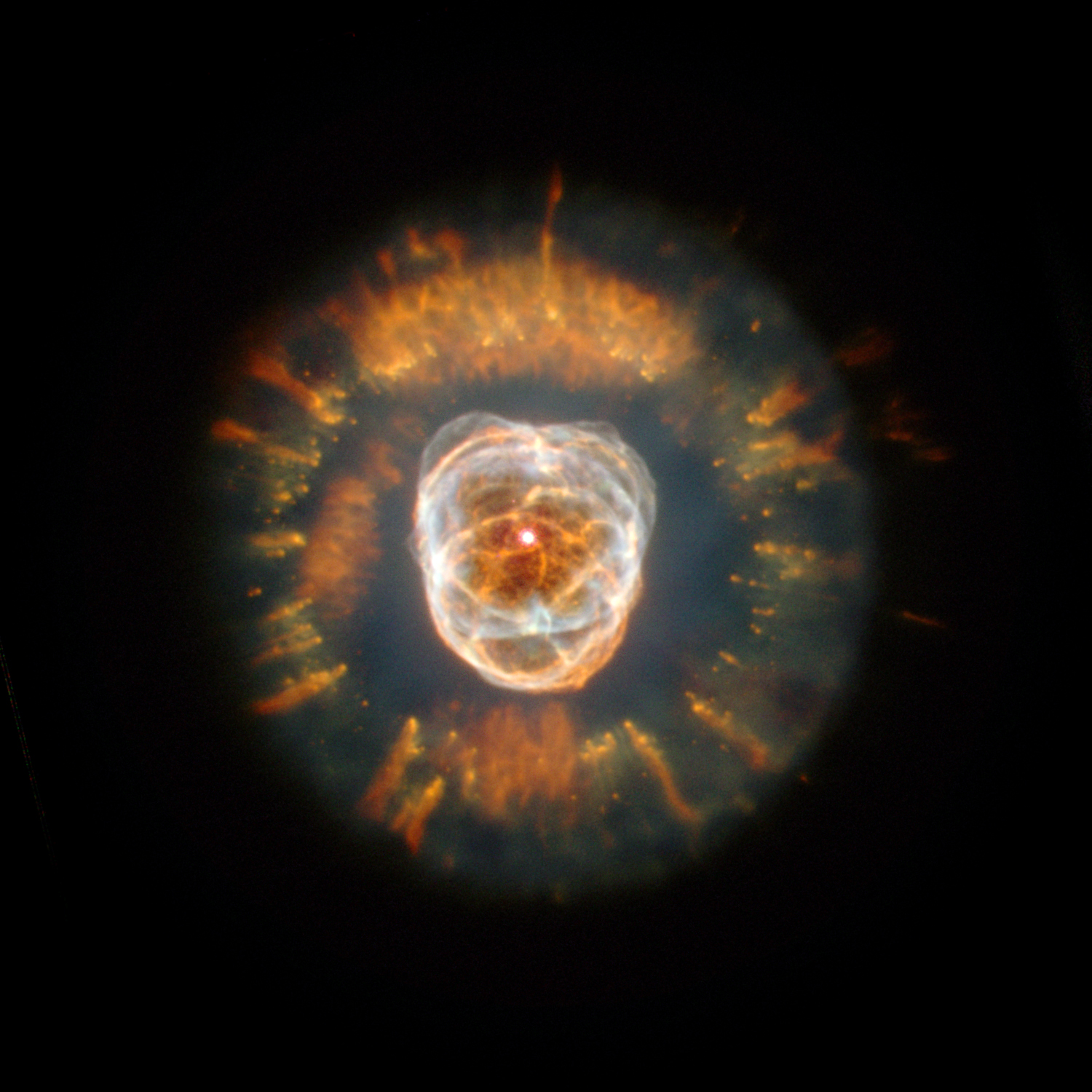
NGC 2392 also known as Caldwell 39, the clown face nebula and the eskimo nebula lies 3,000 light years away from Earth, located in the constellation of Gemini. A dying star sits at the center of the gas cloud, ejecting it's outlayers into the cosmos. The outer ring surrounding the dying star is made up of comet like structures which have streams of gas flowing from them, created by stellar winds coming from the central star. NGC 2392 was first discovered by William Herschel in England on the 17th of January 1787.
The image above was captured by the Hubble Space Telescope.
Tuesday, 15 November 2016
Pillars of Creation
The image above is composed of 32 sepearate images collected from the Hubble space telescope.
Located 8,000 light years away from earth in the eagle nebula, the pillars of creation are estimated to be between 3-4 million light years in length. The star forming pillars are made up mostly of dust and Hydrogen, the gas within the pillars are literally evarporating away due to the surrounding heat radiating from nearby stars. Some theorists speculate that the pillars may have been struck by a shockwave from a supernova almost 7,000 years ago. Because light travels at a "constant" speed, we won't see the destruction of the pillars for another 1,000 years. Other theorists state that stronger volumes of x-ray and radio radiation would have been measurable if the pillars had indeed been struck by a shockwave, but this is not the case.
|
Tuesday, 18 October 2016
Pacman Nebula ( NGC 281)

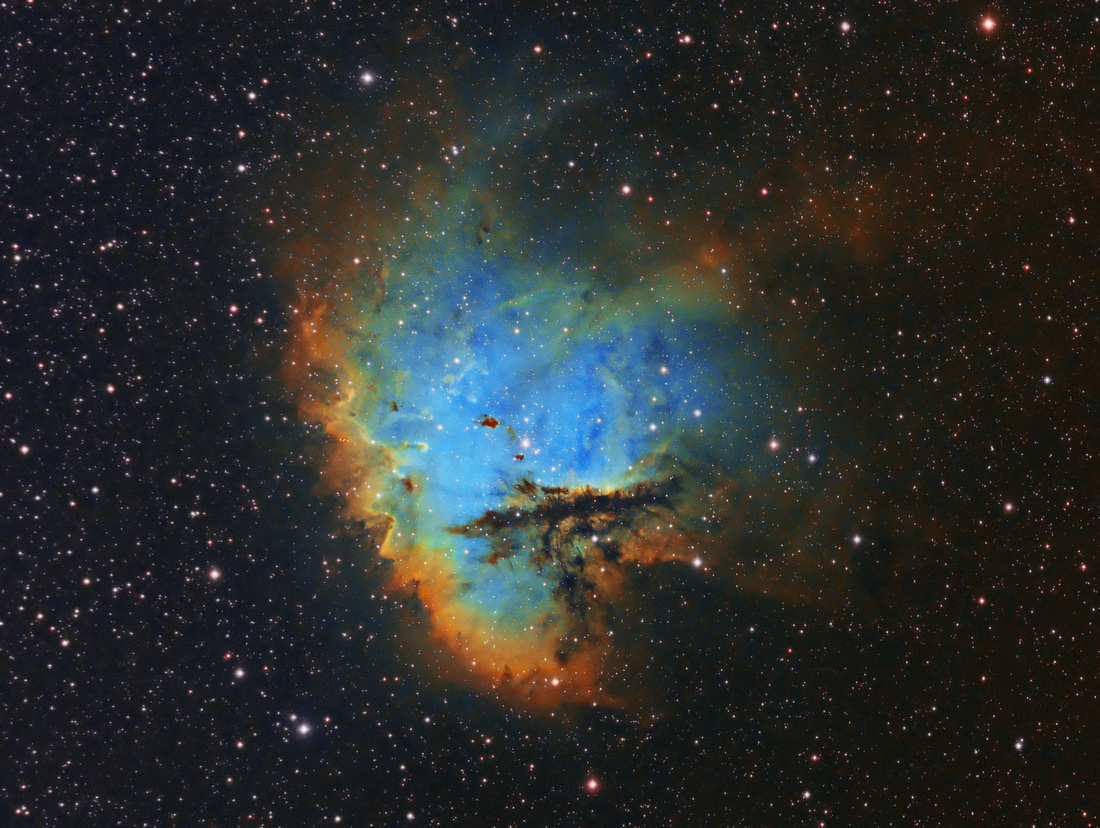
NGC 281 ( PacMan nebula ) is located in the constellation of Cassiopeia, 10,000 light years away from Earth. NGC 281 has a diameter, roughly spanning to around 90 light years in length.
NGC 281 is made up of a open star cluster which contains a few thousand stars, the multiple star HD5005 and dense clouds of cosmic dust and gas called Bok Globules. It is the luminosity of the stars within the nebula that cause the gases to glow, which can be seen in the image above.
The nebula was discovered by E.E Barnard in August 1883.
Bara Gumbad
Bara Gumbad is a historic monument situated in Delhi, India in Lodhi gardens. The monument is thought to have been constructed in around 1490CE. The exact purpose for the construction of the monument is unkown and still remains a mystery to this date. Bara Gumbad is 95ft high, 66ft wide and 66ft long. The monument is assembled of red, black, grey quartzite and sandstone. The interior of the monument is made up of various forms of artwork, colored tiles and elaborat carvings and inscriptions.
Thursday, 23 June 2016
The Hour Glass Nebula
![]() |
| Image was took from the Hubble Space Telescope. |
The Hour Glass Nebula is a planetary nebula, located 8,000 light years away from Earth, in a small constellation named Musca. A planetary nebula is a giant cloud of gas formed from a Sun-like star undergoing the last stages of its life.
Near A Star's death, it blasts away its outer layers, leaving the stars dense core behind emitting ultra violet light, which ionises the gases around the star, causing the gases to glow. Different colours within the photo tells us about certain elements that are present. The red colours tells us that Nitrogen is present, the green colour tells us that Hydrogen is present and the blue colour tells us that Oxygen is present. The star's dense core will eventually cool down to the point where the forces of gravity will push it together to create a White Dwarf.
Wednesday, 18 May 2016
The Pinwheel Galaxy
M101 also known as the Pinwheel Galaxy, is a giant spiral disk, made up of stars, dust and gas located 23 million light years away from Earth, in the constellation of Ursa Major. The galaxy is 170,000 light years across in diameter, has a mass of around 110 billion solar masses with a black hole around 30 solar masses sitting at its centre .The galaxy holds giant molecular hydrogen clouds, which pull together under their own gravitational force, which in turn creates stars. The Pin wheel is home to over 1 trillion stars, with roughly 100 billion of these stars being very similar to our own Sun.
The photo above is the most detailed image of a spiral galaxy that Hubble has ever captured. The image is composed of 51 individual Hubble exposures. The shape of the galaxy is formed due to gravitational forces and stellar winds. The blue areas in the image are regions where new stars have formed, whilst the bright centre of M101 holds very old stars.
Sunday, 15 May 2016
Veil nebula supernova remnant.
The image above shows the Veil nebulae supernova remnant, took from NASA's Hubble Telescope. The image is composed of 6 separate images, each image covers a distance of 2 light years. When all 6 images are put together it reveals this stunning view from the remains of a massive star, that exploded over 8,000 years ago. That star had a mass 20 times larger than that of our own sun. Different gases are contained within the remnant and are shown in different colours to create the image. The red/ orange colours tell us that Hydrogen is present, the green colours tell us that Sulphur is present and the blue colours tells us that Oxygen is present.
Subscribe to:
Posts (Atom)