Monday, 28 November 2016

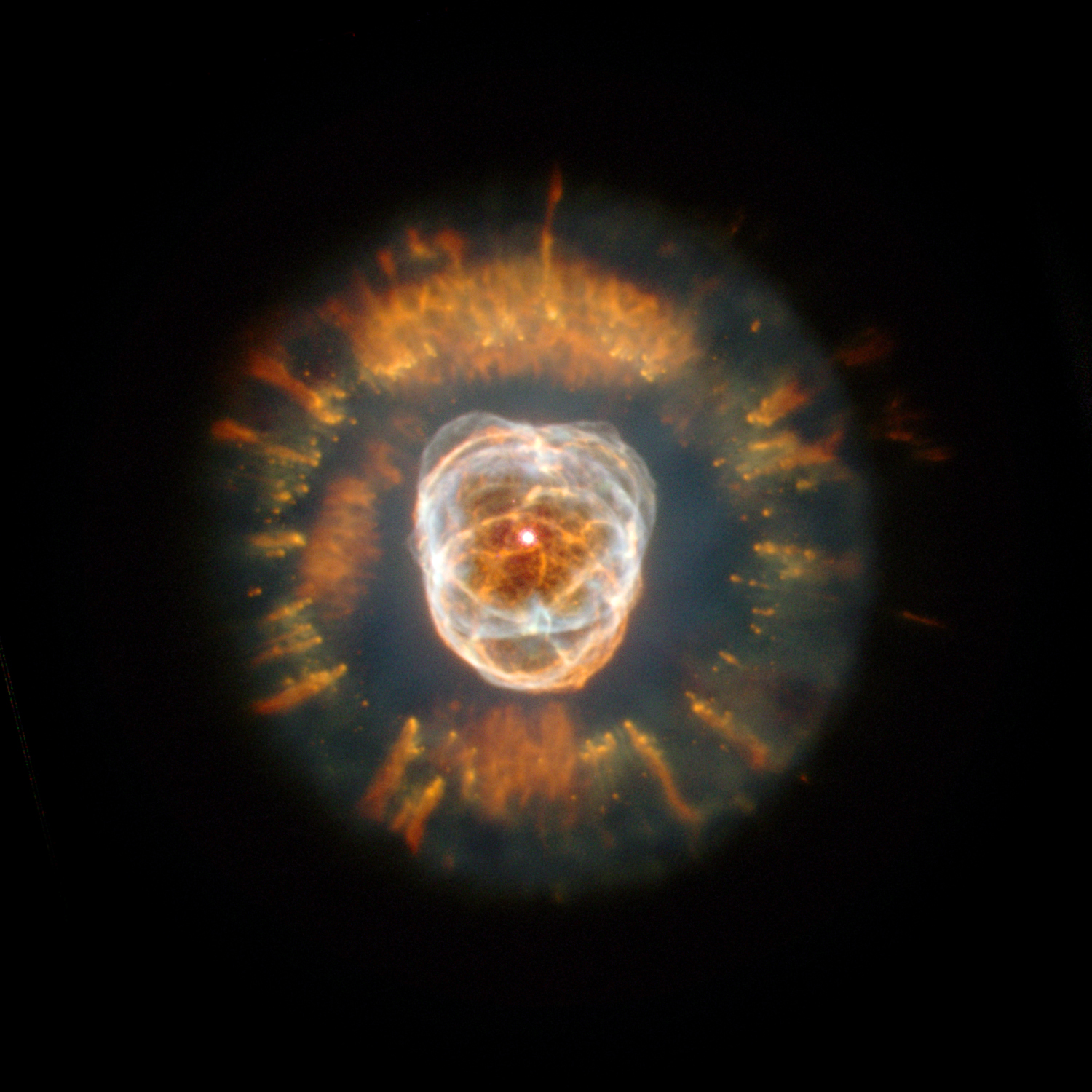
NGC 2392 (Eskimo Nebula)


NGC 2392 also known as Caldwell 39, the clown face nebula and the eskimo nebula lies 3,000 light years away from Earth, located in the constellation of Gemini. A dying star sits at the center of the gas cloud, ejecting it's outlayers into the cosmos. The outer ring surrounding the dying star is made up of comet like structures which have streams of gas flowing from them, created by stellar winds coming from the central star. NGC 2392 was first discovered by William Herschel in England on the 17th of January 1787.

The image above was captured by the Hubble Space Telescope.


Tuesday, 15 November 2016

Pillars of Creation

The image above is composed of 32 sepearate images collected from the Hubble space telescope.


Located 8,000 light years away from earth in the eagle nebula, the pillars of creation are estimated to be between 3-4 million light years in length. The star forming pillars are made up mostly of dust and Hydrogen, the gas within the pillars are literally evarporating away due to the surrounding heat radiating from nearby stars. Some theorists speculate that the pillars may have been struck by a shockwave from a supernova almost 7,000 years ago. Because light travels at a "constant" speed, we won't see the destruction of the pillars for another 1,000 years. Other theorists state that stronger volumes of x-ray and radio radiation would have been measurable if the pillars had indeed been struck by a shockwave, but this is not the case.


Tuesday, 18 October 2016

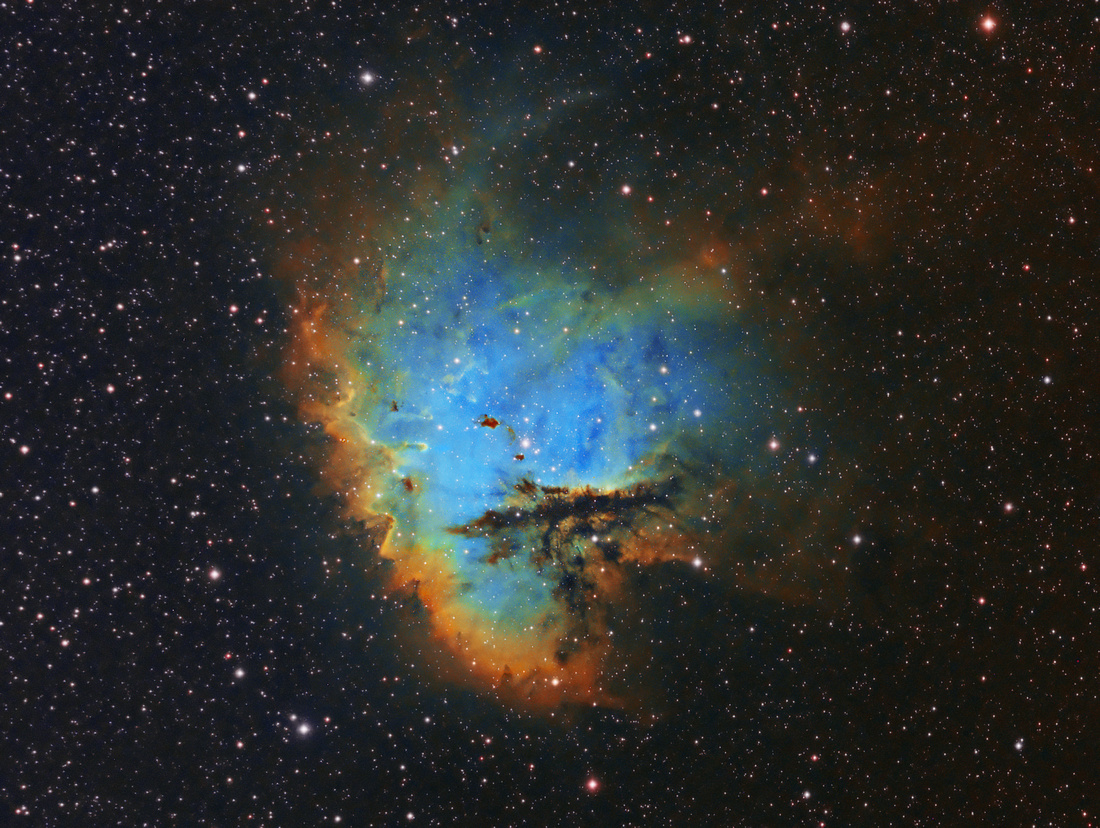
Pacman Nebula ( NGC 281)


NGC 281 ( PacMan nebula ) is located in the constellation of Cassiopeia, 10,000 light years away from Earth. NGC 281 has a diameter, roughly spanning to around 90 light years in length.
NGC 281 is made up of a open star cluster which contains a few thousand stars, the multiple star HD5005 and dense clouds of cosmic dust and gas called Bok Globules. It is the luminosity of the stars within the nebula that cause the gases to glow, which can be seen in the image above.

The nebula was discovered by E.E Barnard in August 1883.

Bara Gumbad


Bara Gumbad is a historic monument situated in Delhi, India in Lodhi gardens. The monument is thought to have been constructed in around 1490CE. The exact purpose for the construction of the monument is unkown and still remains a mystery to this date. Bara Gumbad is 95ft high, 66ft wide and 66ft long. The monument is assembled of red, black, grey quartzite and sandstone. The interior of the monument is made up of various forms of artwork, colored tiles and elaborat carvings and inscriptions.

Thursday, 23 June 2016

The Hour Glass Nebula

Image was took from the Hubble Space Telescope.


The Hour Glass Nebula is a planetary nebula, located 8,000 light years away from Earth, in a small constellation named Musca. A planetary nebula is a giant cloud of gas formed from a Sun-like star undergoing the last stages of its life. 

Near A Star's death, it blasts away its outer layers, leaving the stars dense core behind emitting ultra violet light, which ionises the gases around the star, causing the gases to glow. Different colours within the photo tells us about certain elements that are present. The red colours tells us that Nitrogen is present, the green colour tells us that Hydrogen is present and the blue colour tells us that Oxygen is present. The star's dense core will eventually cool down to the point where the forces of gravity will push it together to create a White Dwarf. 

Wednesday, 18 May 2016

The Pinwheel Galaxy


M101 also known as the Pinwheel Galaxy, is a giant spiral disk, made up of stars, dust and gas located 23 million light years away from Earth, in the constellation of Ursa Major. The galaxy is 170,000 light years across in diameter, has a mass of around 110 billion solar masses with a black hole around 30 solar masses sitting at its centre .The galaxy holds giant molecular hydrogen clouds, which pull together under their own gravitational force, which in turn creates stars. The Pin wheel is home to over 1 trillion stars, with roughly 100 billion of these stars being very similar to our own Sun.

The photo above is the most detailed image of a spiral galaxy that Hubble has ever captured. The image is composed of 51 individual Hubble exposures. The shape of the galaxy is formed due to gravitational forces and stellar winds. The blue areas in the image are regions where new stars have formed, whilst the bright centre of M101 holds very old stars.

Sunday, 15 May 2016

Veil nebula supernova remnant.


The image above shows the Veil nebulae supernova remnant, took from NASA's Hubble Telescope. The image is composed of 6 separate images, each image covers a distance of 2 light years. When all 6 images are put together it reveals this stunning view from the remains of a massive star, that exploded over 8,000 years ago. That star had a mass 20 times larger than that of our own sun. Different gases are contained within the remnant and are shown in different colours to create the image. The red/ orange colours tell us that Hydrogen is present, the green colours tell us that Sulphur is present and the blue colours tells us that Oxygen is present.