Tuesday, 28 March 2017

Pillars of Ashoka


The pillars of Ashoka are a collection of pillars dispersed throughout the Indian subcontinent, during Emperor Ashoka's reign of the Mauryan Empire.
The Emperor had inscriptions carved into the pillars, containing information about the Emperor's beliefs and ideas towards the teachings and philosophies of Buddhism. The pillars stand roughly 15 meters in height and weigh about 50 tons each. These pillars where then sent to areas like Pakistan, Nepal, Afghanistan and Bangladesh. The pillar shown in the image is believed to be one of 30 sandstone pillars inscribed with a Buddhists based moral code. The four lion pillar was constructed by Emperor Ashoka. The lion figure has since become the Republic of India's modern national emblem.

Friday, 17 March 2017

VY Canis Majoris.


VY Canis Majoris can be seen as the brightest star in the image above.


The Hypergiant VY Canis Majoris lies roughly 4,500 light years away from Earth in the constellation of Canis Major. It is one of the largest stars currently known within the Milky Way Galaxy, 1,700 times bigger than our Sun. Hypergiants are some of the biggest and most luminous stars in our known Universe, but only last for a few million years. Hypergaints like VY Canis Majoris are extremely rare stars to locate within our Galaxy. The first person to discover VY Canis Majoris was a French astronomer named Joseph Jerome Francois de Lalande in 1801.
The image above was captured at the Rutherford Observatory in Columbia University, New York, United States.


Saturday, 11 March 2017

Mystic Mountain


The Mystic Mountain is vast area located roughly, 7,700 light years away from Earth in the Carina Nebula. The mountain is a stellar nursery, home to newly born stars, reaching a peak of around 3 light years (17,670,000,000 000 miles) in height. The stars surrounding and forming within the cloud, gives of huge amounts of heat and radiation, which ionizes the surrounding gases, causing them to glow. The image above was captured by Wide Field Camera 3 on the Hubble Space Telescope.

Sunday, 12 February 2017

Ring Nebula (Messier 57)


Messier 57 (M57) also known as the Ring Nebula, sits 2,300 light years away from Earth, in the constellation of Lyra and is roughly 1 light year in size. Its understood that the nebula would of once been a giant sun like star, before its outer shells where blown apart, as the star began its transformation into a white dwarf. The star at the center of the nebula is made up mostly of Carbon and Oxygen. It is roughly 200 times brighter than our own sun and has a surface temperature of around 125,500 ± 5,200 kelvin. The blue hue that surrounds the star is Oxygen gas that has been ionized by the central star, whilst the red hue is a mixture of both Hydrogen and Nitrogen. The red wavy structures surrounding the nebula would have been the first layers of material ejected from the star, as it began to evolve into a white dwarf.
The nebula was first discovered by Antoine Darquier de Pellepoix, who was a french astronomer, in January 1779. The nebula was first photographed by the Hungarian astronomer Eugene von Gothard in 1886.

This image above is composed of visible light data took from the Hubble Space Telescope and infrared data collected from the ground based Large Binocular Telescope in Arizona.

Monday, 6 February 2017

NGC 6357


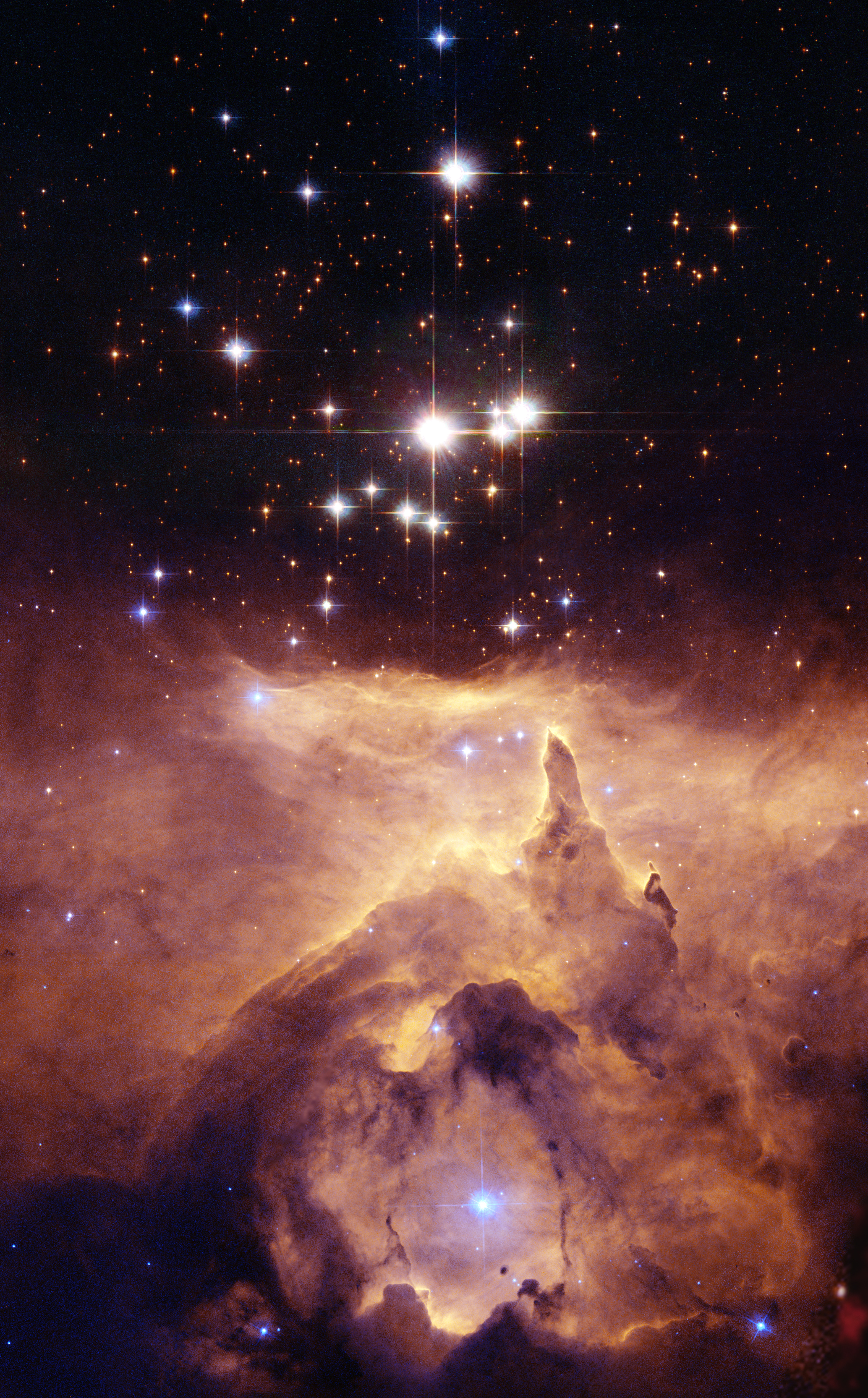
NGC 6357 is a gigantic cloud of interstellar gas and dust, made up of copious amounts of hydrogen, which makes it the perfect spot for star formation to take place. The nebula sits 8,000 light years away from Earth in the constellation Scorpius. The nebula is home to three popular know star clusters called G353.1 + 0.36, G353.2 + 0.7 and Pismis 24. Both star clusters, G353.1+0.36 and G353.2+0.7 hold around 1,600 stars. Pismis 24 is the third star cluster which contains various massive stars such as Pismis 24-1, which is estimated to be 300 times bigger than our own Sun and can be seen in the image above, near the center of the nebula.
The image above was captured by the Hubble Space Telescope.

Thursday, 2 February 2017

Thors Helmet- NGC 2359


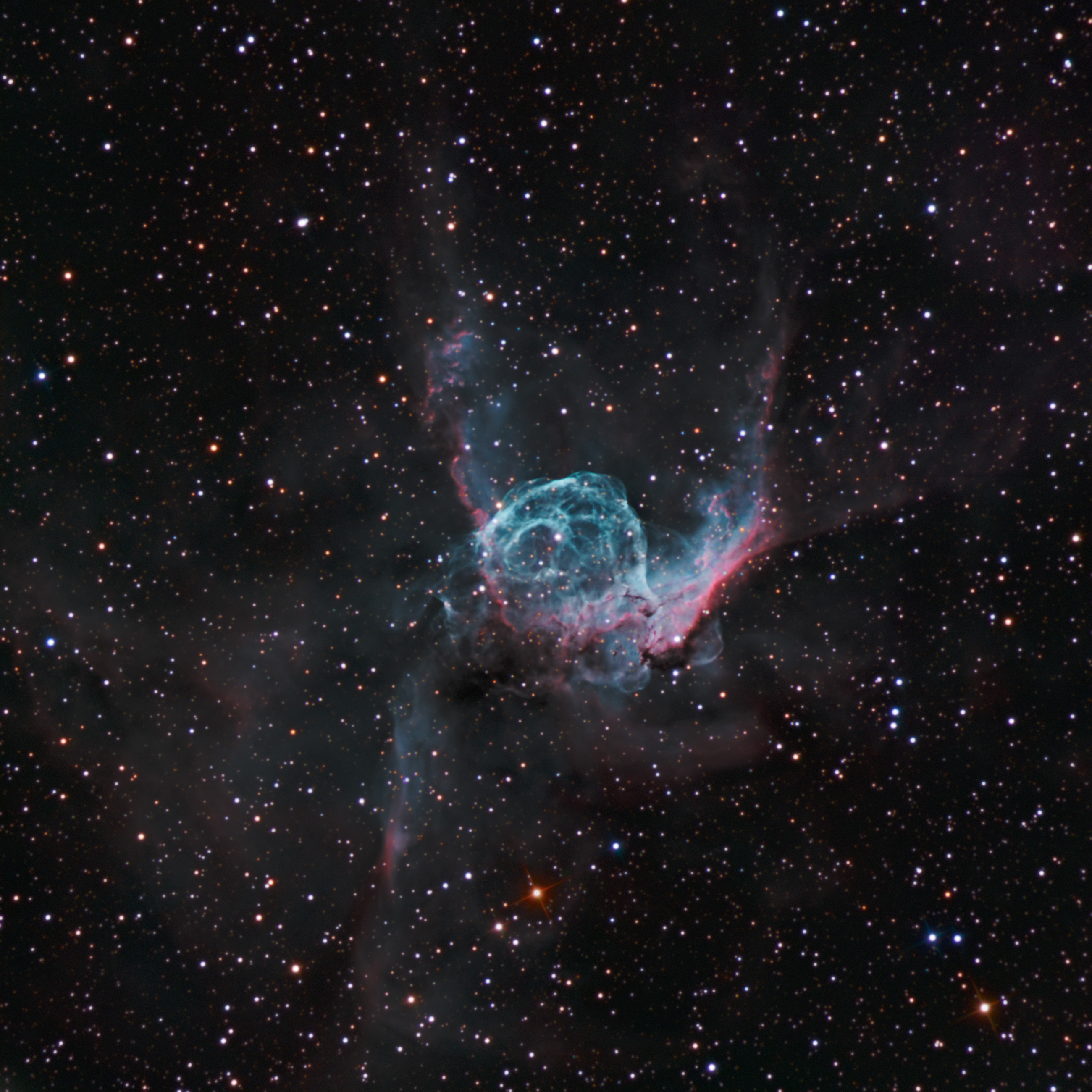
NGC 2359 sometimes referred to as Thors Nebula, is the title of a nebula located 12,000 light years away from Earth, in the constellation Canis Major. The nebula is roughly 35 light years in length and holds a huge Wolf Rayet Star at its center. This Wolf Rayet Star is massive, it has completely burnt off its outer layer of hydrogen and has left helium and heavier elements fusing in its core. It is estimated to have a surface temperature between 30,000 and 250,000 kelvin and is calculated to be thousands of times brighter than our own Sun. Stellar winds emitted from the central star distort and shape the gas that surrounds it. The image above was captured at the Sierra Remote Observatory in California.

Wednesday, 25 January 2017

Sharpless 2-106 (The Cosmic Angel)


Sharpless 2- 106 also known as the cosmic angel, is a nebula located roughly 2,000 light years away from Earth in the constellation of Cygnus. At the center of the nebula lies a massive star which emits large plooms of extremely hot gas from either end of its poles, seen in the image above. The central star is referred to as S106 IR or S106IRS 4. The central star is roughly 17 times larger than our sun with a surface temperature of around 40,000 Kelvin. The nebula is about 2.2 light years in size and contains areas where star formation takes place, being home to brown dwarf stars and protostars. Heat emitted from these surrounding stars ionizes the gases within the nebula, which causes the gas clouds to glow.

The image above was captured by the wide field camera 3 on the Hubble Space Telescope.